Every Mooresville parent has watched a child sit eighteen inches from a tablet for an hour and wondered what it is doing to their eyes. The honest answer is more modest than the headlines: screens do not permanently damage children's eyes, but heavy near work causes real, reversible strain, and the screen era has a habit of hiding ordinary vision problems behind an assumption that it is just the tablet. The skill for parents is telling the difference.
| What you notice | What it often means | What to do |
|---|---|---|
| Squinting at the TV or board | Possible nearsightedness developing | Book a comprehensive exam, do not wait for the school screening |
| Rubbing eyes, complaints of tired eyes after reading | Eye strain, or a focusing problem | Breaks first; exam if it persists with books too |
| Holding books and tablets very close | May be habit, may be vision | Mention it at the next exam; watch for other signs |
| Headaches at the end of the school day | Focusing or eye-teaming effort | Exam, since screen breaks do not fix a focusing issue |
| An eye turning in or out, even occasionally | Eye alignment problem | Book promptly; alignment affects vision development |
| Losing place while reading, avoiding homework | Sometimes vision, sometimes not | Rule vision out with an exam before assuming behavior |
What screens actually do
Staring at near distances holds the focusing system in one position for long stretches, and blinking drops dramatically during screen use, which dries the eye surface. The result is tired, sore, sometimes blurry-at-distance eyes that recover with rest. The widely taught fix is the 20-20-20 rule: every twenty minutes, look at something twenty feet away for twenty seconds. For children, the practical version is simpler: screens in sessions, with real breaks between them, and outdoor time daily, which research consistently links with slower development of nearsightedness in kids.
Why a screening pass is not the end of it
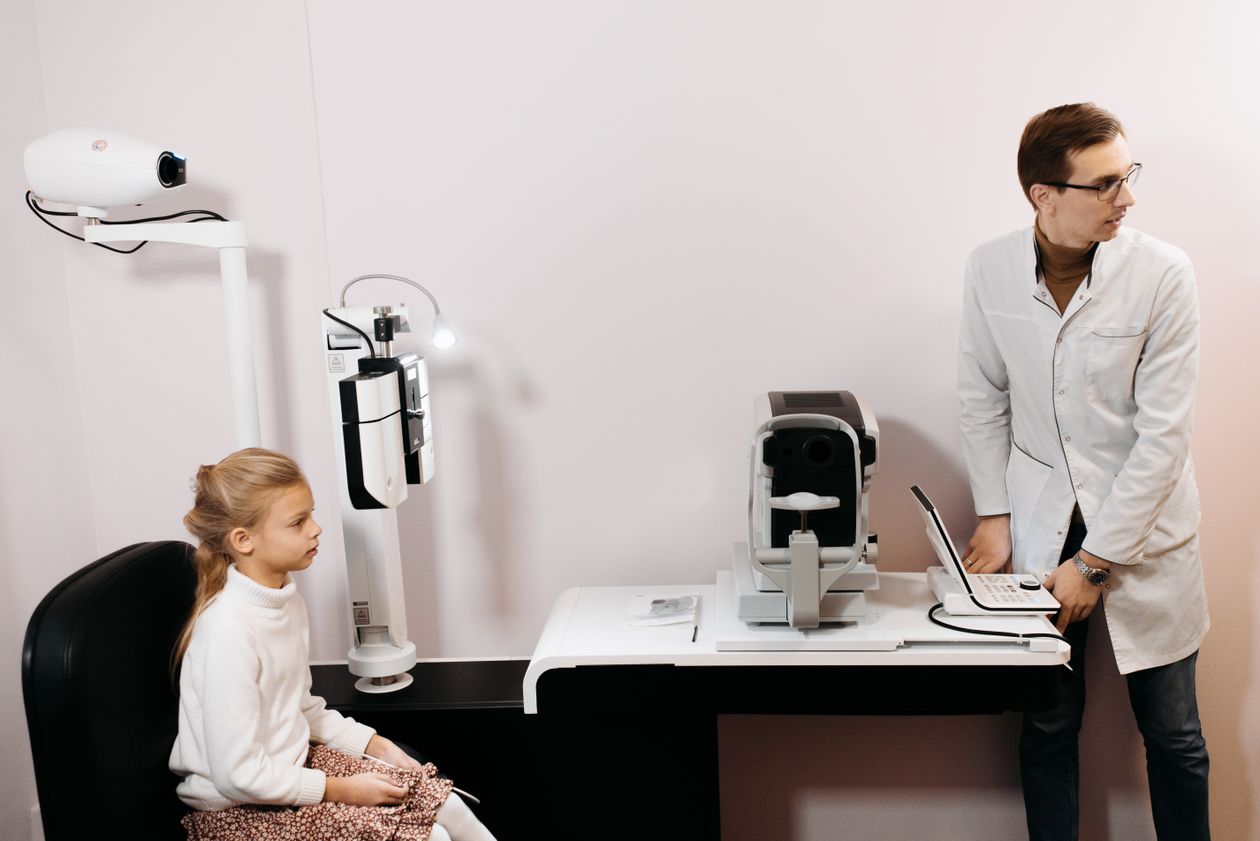
School and pediatric screenings check distance sharpness. They do not measure focusing stamina, eye teaming, or near vision, the systems homework actually loads. A child can pass a screening and still be working twice as hard as classmates to read. When behavior on the table above shows up, a comprehensive exam at a practice used to examining children, like Grace Vision Care in Mooresville, is the check that answers it.
Setting up a child's screen and study space
Small ergonomic changes carry most of the benefit attributed to expensive products. Screens belong roughly an arm's length away and slightly below eye level, so the eyes rest in a natural downward gaze that exposes less surface to drying air. Room lighting should be even, without a bright window directly behind the screen or a dark room around a glowing tablet, both of which force the eyes to work against contrast. For homework, a desk lamp and printed-page breaks matter as much as the device rules, because paper reading at close range for an hour is the same focusing work as a screen, just quieter about it.
Outdoor time: the underrated prescription
The most consistent finding in children's vision research of the past two decades is not about screens at all. It is that children who spend more time outdoors develop nearsightedness less often and more slowly, with daylight exposure the suspected mechanism. Piedmont weather cooperates for most of the year, and the practical target many doctors cite is around two hours of outdoor time a day across school, sports, and play. No app sells that, and no lens provides it. For Mooresville families it is also the easiest intervention on this page to actually enjoy.
Finally, trust the pattern over the incident. One afternoon of squinting at a cousin's tablet means little. Squinting that follows a child across settings, at school, at home, at distance and near, across weeks, is the signal this page is really about. Children adapt to blur so completely that the adaptation itself becomes the symptom, and the adults around them are the only monitoring system they have.
Common questions
Do blue-light glasses help children?
The evidence that blue light from screens harms eyes or that filtering it relieves strain is weak. Breaks, distance, and lighting do the real work. Spend on the exam, not the coating, if you must choose.
How close is too close for a tablet?
There is no magic distance, but habitually holding screens a few inches from the face deserves a mention at an exam, and encouraging roughly an arm's length is a reasonable house rule.
My child passed the school screening but struggles with reading. Now what?
Book a comprehensive exam and describe the reading behavior specifically. Focusing and eye-teaming problems are the classic screening misses, and they are very treatable once found.
Photos in this guide are representative stock images.
← All guides from Grace Vision Care← Back to Grace Vision Care